

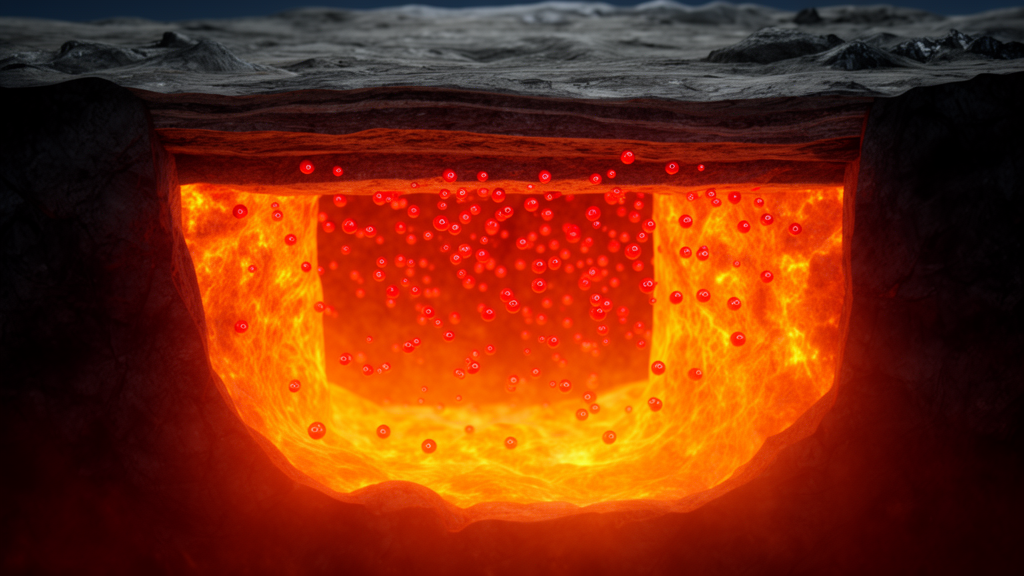
A recent study (published in Science Advances) indicates that Earth’s metallic core has been leaking primordial hydrogen, along with helium- 3 and certain tungsten isotopes, into the mantle for much of the planet’s 4.5- billion- year history.
Researchers from the University of Science and Technology of China used machine- learning- boosted path- integral simulations to model the quantum behavior of light atoms (especially hydrogen) under the extreme pressures and temperatures of the deep Earth. They focused on deuterium- to-hydrogen (D/H) ratios and related isotope signatures.
Key points from the work and related coverage:
- Magma- ocean crystallization alone cannot explain the extremely low (deuterium- depleted) hydrogen isotope signatures seen in some ocean- island basalts (OIBs), such as those from Baffin Island and Iceland. These lavas rise from near the core, mantle boundary and carry chemical “messengers” from depth.
- Primordial (solar- nebula) hydrogen stored in the core preferentially partitions as the lighter isotope. As it migrates upward, it lowers the mantle’s local D/H ratio. Supporting evidence comes from high ³He/⁴He ratios (primordial helium- 3 mixed with radiogenic helium- 4) and tungsten- isotope anomalies that also point to core material.
- The hydrogen does not appear as free liquid water in the core; once it enters the oxygen- rich mantle it can form water bound in minerals. Over geologic time this exchange has dynamically altered the deep mantle’s composition rather than leaving purely “relic” signatures from early differentiation.
This builds on earlier experimental work (e.g., 2026 Nature Communications studies) showing the core itself may contain the equivalent of roughly 9- 45 oceans’ worth of hydrogen (0.07- 0.36 wt %), acquired mainly during Earth’s accretion rather than solely from later cometary delivery. Some of that reservoir appears to have been leaking upward for billions of years.
The quantities involved are tiny on human timescales, but the long-term chemical exchange helps explain observed isotope anomalies in surface rocks and improves models of Earth’s volatile budget, mantle dynamics, and early water origins. The findings reinforce that the core- mantle boundary is not a perfect chemical barrier.

Hydrogen moves from Earth’s core to the mantle primarily through limited chemical exchange and diffusion (or related transport) across the core, mantle boundary (CMB), rather than large- scale bulk flow.
This process has operated over billions of years and is supported by isotope evidence (especially low δD values) in ocean- island basalts that rise from near the CMB.
Key mechanisms
- Chemical reactions and exchange at the CMB
Subducted hydrous minerals can dehydrate in the lowermost mantle, releasing hydrogen (or water). This reacts with iron- silicon alloys from the outer core, forming phases such as iron hydride (FeHₓ) or related compounds. The reaction enables bidirectional exchange: hydrogen can enter the mantle side while silicon (as SiO₂) may move the other way. A hydrogen- rich, lower- density layer can form near the top of the outer core or accumulate at the base of the mantle (potentially contributing to ultralow- velocity zones). Because of its low density, some of this hydrogen- rich material migrates into the lowermost mantle. - Diffusion (including isotopic diffusion)
Atomic diffusion of hydrogen across the CMB is a viable transfer route. Hydrogen is highly mobile under extreme pressures and temperatures. Even without strong concentration gradients, isotopic diffusion can transfer light (deuterium- depleted) hydrogen into the mantle if the core and mantle are not in isotopic equilibrium. Estimates of hydrogen diffusivity in lower- mantle minerals indicate that regions of tens of kilometers can be affected over geologic time. - Entrainment into mantle plumes
Once hydrogen (or hydrogen- bearing material) reaches the lowermost mantle, it can be incorporated into upwelling mantle plumes. These plumes rise to the surface, carrying the core- derived isotopic signatures (low δD, high ³He and ⁴He, tungsten anomalies, etc.) that appear in certain ocean- island basalts (e.g., Baffin Island, Iceland).
Important context
- The core acquired much of its hydrogen early, during planetary accretion and metal, silicate differentiation (hydrogen preferentially partitions into the metallic phase and is isotopically light).
- The quantities transferred are small on human timescales but accumulate over Earth’s history, dynamically modifying deep- mantle isotope compositions.
- Solid- state diffusion of heavier elements is extremely slow in the lower mantle, so hydrogen’s relative mobility makes it a more effective tracer of core- mantle interaction.
- Superionic states of iron hydride (where hydrogen atoms move fluid- like within a solid iron lattice) may also play a role near the CMB under the extreme conditions there.

Tungsten isotope anomalies, particularly involving the isotope ¹⁸²W, are important geochemical tracers used to study early Earth differentiation and possible ongoing exchange between Earth’s core and mantle.
Background: The ¹⁸²Hf- ¹⁸²W system
- ¹⁸²Hf (hafnium- 182) is a short- lived radioactive isotope that decays to ¹⁸²W (tungsten- 182) with a half- life of about 8.9 million years.
- During Earth’s formation, tungsten (moderately siderophile and “iron- loving”) preferentially entered the metallic core, while hafnium (lithophile and “rock- loving”) stayed in the silicate mantle.
- As a result, the core developed a strongly negative ¹⁸²W signature (estimated μ¹⁸²W ≈ −200 to −220), while the mantle became relatively enriched in ¹⁸²W.
- μ¹⁸²W is the deviation of the ¹⁸²W/¹⁸⁴W ratio from a terrestrial standard, measured in parts per million (ppm).
Observed anomalies
- Ancient rocks (Hadean- Archean, >2.7 billion years old) often show positive ¹⁸²W anomalies (μ¹⁸²W up to +15 to +20 ppm), reflecting the early mantle before significant later mixing.
- Modern ocean- island basalts (OIBs) from certain hotspots (Hawaii, Samoa, Iceland, Réunion, Kerguelen, etc.) frequently show negative ¹⁸²W anomalies (μ¹⁸²W as low as −15 to −23 ppm). These are often correlated with high ³He/⁴He ratios.
Interpretation in the context of core leakage
In the recent research on hydrogen leakage from the core (and related studies), negative ¹⁸²W anomalies are interpreted as evidence of core- derived material mixed into the lowermost mantle:
- Even a small contribution (<1%) of core material can shift the mantle’s tungsten isotope ratio toward negative values because the core is so strongly depleted in ¹⁸²W.
- Proposed transfer mechanisms include isotopic diffusion across the core- mantle boundary or limited chemical exchange (without bulk entrainment of metal, which would also raise highly siderophile element concentrations, something not observed).
- These tungsten anomalies often co- occur with other core- like signatures (high ³He/⁴He, low δD hydrogen isotopes, and sometimes ruthenium isotope anomalies), supporting the idea of selective, long-term leakage of primordial components from the core into mantle plumes.
Alternative explanations
Some researchers argue the negative anomalies could instead reflect:
- Preservation of early silicate differentiation products (magma- ocean processes) isolated in the deep mantle for billions of years, or
- An overabundance of late- accreted (meteoritic) material.
However, the combination of negative ¹⁸²W with other isotopic systems (helium, hydrogen, etc.) increasingly favors some form of core- mantle interaction for many plume sources.
In short, tungsten isotope anomalies act as a “fingerprint” of very early planetary differentiation and provide one of the key lines of evidence that Earth’s core is not completely isolated from the mantle.

Hydrogen isotopes reveal water leakage from the core
This is the open- access Science Advances paper (DOI: 10.1126/sciadv.aei4756; published ~9 October 2026) titled “Hydrogen isotopes reveal water leakage from the core”, by Yu Zhang, Wenzhong Wang (corresponding author, University of Science and Technology of China), Zhongqing Wu, and colleagues.
Main finding
Extremely low (deuterium- depleted) hydrogen isotope ratios (δD values as low as about −144 ‰) measured in some ocean- island basalts (OIBs), especially from Baffin Island, cannot be explained by crystallization of an early magma ocean. Instead, they are best accounted for by ongoing leakage of primordial, isotopically light hydrogen (and associated volatiles) from Earth’s metallic core into the mantle over geologic time.
Key methods and results
- The team used machine- learning- boosted path- integral molecular dynamics simulations to quantify hydrogen isotope fractionation under deep- Earth conditions, accounting for quantum effects important for the light hydrogen atom.
- They modeled magma- ocean crystallization (bridgmanite- melt partitioning, varying pressure, temperature, water content, and fractionation factors). The models produce an essentially homogeneous D/H distribution in the primitive mantle; mineral- melt fractionation is too weak to generate the extreme depletions observed in OIBs.
- Observed low δD values, when combined with high ³He/⁴He ratios, negative ¹⁸²W anomalies, and other core- like signatures in the same plume systems, point to selective transfer of primordial volatiles across the core- mantle boundary.
- Light hydrogen that entered the core during accretion (preferentially partitioned into metal) continues to migrate upward. Once in the oxygen- rich mantle it can form water bound in minerals; the process has dynamically modified deep -mantle isotope signatures throughout Earth’s history rather than preserving simple “relic” reservoirs from early differentiation.
Broader implications
The results support the idea that Earth’s core is a long- term reservoir of hydrogen (consistent with separate experimental work estimating the equivalent of many oceans’ worth of H in the core) and that core- mantle chemical exchange has been active for billions of years. This exchange helps explain isotope anomalies in surface rocks and contributes to models of Earth’s water budget and mantle dynamics.
The paper is open- access under a Creative Commons license; the full text, figures, and supplementary materials (including sensitivity tests of the crystallization models) are available at the link you provided. Secondary coverage (e.g., ScienceAlert) has summarized the findings for a general audience.
Journal: Science Advances, Vol 12, Issue 41
Published: 9 Oct 2026
Authors: Yu Zhang, Wenzhong Wang (corresponding author, University of Science and Technology of China), Zhongqing Wu, and colleagues.
Abstract
Chemical heterogeneities in Earth’s deep mantle may record either preserved primordial reservoirs or later core-mantle exchange, but distinguishing between these origins remains challenging. Hydrogen isotopes offer a sensitive tracer, yet whether magma ocean crystallization could generate a deuterium-depleted deep reservoir has not been quantitatively evaluated. Here, we use machine learning–accelerated path-integral simulations to determine equilibrium hydrogen isotope fractionation between silicate melt and bridgmanite, ringwoodite, and wadsleyite under magma ocean conditions. Incorporating these fractionation factors into a magma ocean crystallization model shows that mineral-melt fractionation is intrinsically weak, producing an essentially homogeneous D/H distribution in the primitive mantle. Magma ocean crystallization therefore cannot generate the extremely low δD values observed in some ocean island basalts. Combined with exceptionally high 3He/4He ratios, these signatures more plausibly reflect selective transfer of primordial volatiles from Earth’s core, implying sustained volatile exchange across the core-mantle boundary.
Share this:


Discover more from Climate- Science.press
Subscribe to get the latest posts sent to your email.