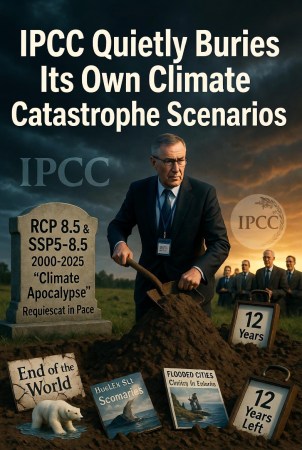

Fritz Vahrenholt, a chemist, former environmental senator in Hamburg, renewable energy executive, and longtime IPCC critic (co-author of Die kalte Sonne), argues in his recent newsletter and interviews that the IPCC is effectively abandoning the most extreme “catastrophic” projections used in prior reports.
This refers to RCP8.5 (from AR5) and its successor SSP5-8.5 (in AR6). These high-end emissions scenarios assumed massive, continued growth in coal use and very high forcing (~8.5 W/m² by 2100), leading to ~3–5°C+ warming by 2100 in many models. Critics (including Vahrenholt) have long called them unrealistic “business-as-usual” portrayals that were often treated as likely outcomes in media, policy papers, and impact studies.
Recent developments confirm key parts of this:
Scenario experts preparing inputs for AR7 have stated that SSP5-8.5 (and similar high-end cases like SSP3-7.0) are now considered implausible for the 21st century, based on renewable cost declines, policy trends, and actual emissions trajectories.
Zeke Hausfather (IPCC AR7 lead author) and others have acknowledged the shift: these scenarios were never meant as the most likely “no policy” path but became overused.
This is a meaningful correction. Thousands of studies and headlines relied heavily on these tails for dramatic impacts (e.g., extreme sea-level rise, ecosystem collapse). Retiring them narrows the upper range of assessed futures.
Shared Socioeconomic Pathways (SSPs) form the core socioeconomic scenario framework used in the IPCC’s Sixth Assessment Report (AR6) and CMIP6 climate modeling. They succeeded (and expanded upon) the earlier Representative Concentration Pathways (RCPs) from AR5 by integrating detailed socioeconomic narratives with emissions and climate outcomes.
SSPs explore how different plausible futures for global society — in terms of population, economic growth, technological development, inequality, governance, and energy/land-use patterns — could influence greenhouse gas emissions, climate change, mitigation challenges, and adaptation capacity.
On the German Federal Constitutional Court (Bundesverfassungsgericht)
Vahrenholt criticizes the court’s 2021 ruling on Germany’s climate law. It struck down parts of the law for insufficient post-2030 targets, citing intergenerational fairness under Article 20a GG (environmental protection), and drew on IPCC material that included extreme scenarios.
He argues this reliance (e.g., on high-warming graphics and projections >3°C) now looks flawed given the scenario revisions, and that the ruling locked in overly aggressive timelines (net-zero by 2045) despite Germany’s tiny share of global emissions (~1–2%). He has co-authored a book fact-checking the decision.
Courts aren’t climate modelers; they rely on expert input. If foundational projections shift, it strengthens arguments for revisiting policy proportionality—especially given Germany’s deindustrialization risks, energy costs, and limited global leverage. However, the ruling’s constitutional logic on future freedoms isn’t automatically voided by updated scenarios.
_____________________________________________________________________________________
Farewell to the end of the world
Vahrenholt: Climate catastrophe prophecy was a soap bubble
In his new newsletter, Prof. Dr. Fritz Vahrenholt clears up the disaster scenarios of the Intergovernmental Panel on Climate Change (IPCC).
“The IPCC authors themselves are also saying goodbye to the catastrophic scenarios of the last two world climate reports,” he states, and immediately deals with the new IPCC predictions. He also describes how the Federal Constitutional Court has made a fool of itself in this context. Frankfurt- live has the story.
Prof. Vahrenholt is not just anyone. The Doctor of Chemistry was Hamburg’s Senator for the Environment from 1991 to 1997. He then went to Deutsche Shell AG as board member for renewable energies. In 2001, he became Chairman of the Board of Directors of the wind turbine manufacturer REpower Systems. He then heads the newly founded group company for renewable energies of RWE AG, Innogy GmbH, until 2012. Since 1999, Vahrenholt has been an honorary professor in the Department of Chemistry at the University of Hamburg. He is also a member of the German Academy of Science and Engineering Acatech. His bestseller “Seveso is everywhere” (1978) was one of the most influential book publications in the early years of the environmental movement. In 2020, his bestseller “Undesirable Truths” (together with Sebastian Lüning) was published, and in February 2022 his book “The Great Energy Crisis – and How We Can Cope with It”.
So, this is what Prof. Vahrenholt reports in his new newsletter:
“The global temperature in April 2026 remained about the same as in March. It is now 0.39 degrees Celsius higher than the long-term average. The cooling trend of the last two years is coming to an end. The average temperature increase since 1979 has been 0.16 degrees Celsius per decade.
This moderate increase was never compatible with the catastrophic scenarios of the Intergovernmental Panel on Climate Change (IPCC), which predicted a temperature increase of 3-5 degrees Celsius by the year 2100 in its horror scenarios.
This has been yesterday’s snow since April 7, 2026.
On this day, scientists from the Intergovernmental Panel on Climate Change have cashed in on the previous doomsday scenarios in a sensational publication.
In politics, the media and science, this should be received as a great relief and lead to an immediate correction of climate policy. But the discussion is not taking place in Germany.
Special broadcast on ARD, special session of the German Bundestag, government statement by the government on the flawed foundations of the Climate Protection Act: None of this.
The climate bogeyman remains exaggerated, because it could be used to make wonderfully green and left-wing politics.
On April 7, 2026, 44 IPCC authors responsible for the Intergovernmental Panel on Climate Change (IPCC) climate scenarios published a groundbreaking publication.
Under the leadership of Prof. Detlef van Vuuren, the scientists explained that the scenarios listed so far in the last two climate reports of 2013/2014 (AR5) and 2021-2023 (AR6), which should lead to temperature increases of up to five degrees Celsius in 2100, are “implausible”.
In these scenarios (RCP 8.5), it was assumed that CO2 emissions would more than triple over the course of this century.
Since the Intergovernmental Panel on Climate Change uses CO2 as the main climate factor in its models, this resulted in frightening temperature increases. According to the latest report (AR6), the RCP 8.5 model should be warmer by 4.4 to 5.7 degrees by 2100.
Read the full story here.



You must be logged in to post a comment.