Global warming, climate change, all these things are just a dream come true for politicians. I deal with evidence and not with frightening computer models because the seeker after truth does not put his faith in any consensus. The road to the truth is long and hard, but this is the road we must follow. People who describe the unprecedented comfort and ease of modern life as a climate disaster, in my opinion have no idea what a real problem is.
h/t Carl – Will woke fossil fuel hating banks like BlackRock have to disclose the risk of being boycotted by GOP states on their SEC climate risk declarations?
Another State Puts Energy-Boycotting ESG-Loving Companies On Notice
In the Commonwealth of Kentucky, GOP leaders are not messing around when it comes to woke ESG — environmental, social, and governance — policies that endanger the Bluegrass State’s economy and the well-being of its citizens.
In addition to joining investigations against companies over their use of ESG in attempts to “decarbonize” the global economy and fighting to keep woke asset management firms from scooping up shares of publicly traded utilities, Kentucky is putting the companies that boycott reliable and affordable energy on notice. [emphasis, links added]
On Tuesday, Kentucky State Treasurer Allison Ball named 11 such financial companies currently boycotting energy companies, following the passage of a 2022 law that directed Ball’s office to publish a list of companies actively engaged in energy boycotts, which then puts said companies on a path toward divestment by the Commonwealth.
…
The updated list of companies engaged in energy boycotts was based on a “careful review of publicly available statements and commitments made by the companies” and includes the following entities:
So far at least the companies affected appear to be shrugging off these state legislature boycotts.
But upsetting regulators is never a good thing if you are a bank.
If banks ignore these warning signals, and continue upsetting GOP legislators with their anti-fossil fuel discrimination, next time they ask for a GFC financial bailout, say if the Chinese economy implodes and drags China exposed banks underwater, they might find nobody at the GOP controlled congress wants to answer their phone call.
The speed limit on motorways should be reduced to 64mph. Restrictions could be imposed on going from one part of your city to another. Short-haul flights might be banned, and rings of cameras built around every major town to levy charges on anyone moving in and out. Almost every day brings calls for some kind of curb on travel. And yet, underneath them all is one simple force: a movement by green extremists to take us back to the dark ages. It is effectively a plot to reinvent feudalism, a time when people rarely left their own villages and were taxed if they dared do so.
That’s why, for all the temptation to ridicule the Great Unwashed, we have to take their politics seriously. It wasn’t some Extinction Rebellion activists but a Commons committee that suggested reducing the speed limit to 64mph (and what is to stop them from taking it to 60mph or 58.32mph?) In London, it is the mayor, Sadiq Khan, who is championing the expansion of the Ulez charge, which will kill road traffic into the capital. Other cities with congestion or pollution charges, like Birmingham, will likely follow suit. Leaders in Oxford and Canterbury, meanwhile, have proposed what many fear will turn out effectively to be restrictions on driving from one zone of their cities to another, unless you have a permit or are willing to pay a hefty fine.
Then there is France, which is banning short-haul flights between cities that are connected by train in under 2.5 hours – which would not be of much use here in Britain, where the rail unions are always striking. The sci-fi writers of the 1950s and 1960s imagined a world where we zipped around effortlessly in robot-driven flying vehicles by the 2030s. Instead, it looks as if we will all be forced to stay at home, venturing out of our local areas once or twice a year when we have a permit to do so, hoping the cameras don’t flash when we pass the one-mile mark.
The environment should be protected. Carbon emissions need to be brought down and air quality improved. It might even be sensible to encourage people to travel at different times to ease congestion, or to create more pedestrian zones to make urban areas more livable. But that isn’t what this is about. Instead, climate change is being used as cover to wage war on the very concept of travel.
Those wanting to restrict it forget that the economy, science, culture and health all depend on people and goods getting from one place to another. There are few forms of economic activity that don’t rely on the movement of these things. Science would make fewer breakthroughs without experts meeting at conferences. Music would be unimaginably duller without the cross-pollination of rhythms, melodies and beats between continents. Our language would be poorer, too.
It is surely not a coincidence that we began to emerge from the Dark Ages into the Renaissance and then into modernity when travellers started linking up Asia, Europe and America, carrying plants, technologies and, most of all, ideas. We risk shutting down that infinite channel of progress with foolish green virtue-signalling.
Working from home won’t save us, and nor can the internet replace real communication. The world of green extremism is closed and neo-medieval, offering about as much opportunity to people as that enjoyed by a 12th-century serf. Even the Great Unwashed couldn’t survive that.
Eco-servitude: environmentalist plans are taking us back to a world where ordinary people were unable to travel CREDIT: Pieter Brueghel the Elder/Getty
Well on Tuesday it was all just too much for the old malthusian and he lashed out at all those right wingers.
60 Minutes extinction story has brought the usual right-wing out in force. If I'm always wrong so is science, since my work is always peer-reviewed, including the POPULATION BOMB and I've gotten virtually every scientific honor. Sure I've made some mistakes, but no basic ones
The poor should stay poor, to allow more for us Hence the concept of “never-to-be-developed countries”
I had no idea Revelle was so spicy:
“No one can blame the Ehrlichs, living within a few miles of the Bay Shore Highway between San Francisco and San Jose, for thinking that the four-fold growth of California’s population since 1930 is a disaster”
I’ll end this medley with a video clip demonstrating what a disgusting, anti-human, anti-freedom, totalitarian statist, Ehrlich always has been. It’s illustrative that he begins by saying he’s not in favor of government interference then goes on to describe all the ways he wants government to interfere.
"You oughta make the FCC see to it that large families are always treated in a negative light on television."
"the government will simply tell you how many children you can have and throw you in jail if you have too many"
Let’s first assume that the highly mobile and ubiquitous blood contains many of the cells in our immune system and are, as a whole and in parts, key to optimal immune function.
Antibodies are studied more than other immune proteins for association with disease. This does not mean that they are more decisive in disease outcomes. Type I interferon likely has far more impact.
Antibodies Are Not the Whole Story of Immune Resilience Toward Cancer
Much is being made of a recent study showing IgG4 antibodies spiking in the blood labs of those who are triple-injected with the mRNA COVID vaccines. Journalists are speculating that this may be the cause of increased cancers in the COVID-vaccinated. But that is not the main reason that the COVID-vaccinated are getting new cancer cases, sometimes aggressive “turbo cancers,” or coming out of remission from earlier cancer.
Rather, there is earlier research that provides more plausible mechanisms for cancer risk, based on abundant prior knowledge of immune function. Let’s look at both the new study on IgG antibodies and earlier research.
The popular fallacy seems to be along these lines: ‘Antibodies are easy to test for. Plus, they are the focus of vaccine development and vaccine action. So therefore we spend a lot of time thinking and talking about them. So therefore they must be important markers of disease outcomes.
So therefore they must be decisive in disease outcomes.’
After focusing my own work on cancer patients for the last 16 years as a naturopathic oncologist, if I made this mistake in thinking, most of my patients would be dead by now from misdirected efforts.
No, cancer remains a mega-problem of DNA damage, immune distraction, disrupted cell signaling, frenzied growth, lack of apoptosis, weakened tissues, angiogenesis, and metabolic derangement, as the principal features of an entity that feeds itself at the expense and to the detriment of the organ and the organism.
These are the principal features of cancer, and they are hard as heck to treat successfully. I discuss that very daunting challenge here.
Herein, let’s call it the IgG4 study. It finds that the triple-jabbed may be developing a non-inflammatory tolerance to even high levels of spike proteins.
That is, rather than having typical dyspnea, cough, olfactory and other full-blown COVID-type symptoms, IgG4 is a tolerant and tolerizing antibody that allows virions and spike protein load to accumulate in the body without the usual symptomatic alarms. Thus, a COVID+ PCR result with mild symptoms, or even no symptoms, often ensues.
This may partly account for the many celebrities and politicians frequently quoted in MSM saying in so many words, ‘I tested positive for COVID, but thanks to my shots, it’s mild.’ Yet their lack of effective immune defeat of SARS-CoV-2 is what prevents their developing a lasting neutralizing immunity.
So they (at least at first) tolerate high spike protein loads and are perpetually vulnerable to recurrent infections. Even more worrisome, what underlies that recurrence of mild symptoms, show the IgG4 study authors, is a precarious derangement of immune function with potentially problematic stockpiling of viral load, spike proteins and antibodies, with potentially devastating consequences for their future health outcomes.
Even a myeloma like abundance of immunoglobulins can create a multiple myeloma-like disease in the COVID-vaccinated, a sludgy protein-laden blood that is harmful to the fine filtration structures, glomeruli, of the kidneys.
That immune deviation, misdirection and derangement has been previously described as pathogenic priming, a maladaptation of the immune system to either ignore or to fight ineffectively against genuine threats, while at the same time focusing its resources to slay the paper tigers of non-threatening antigens.
This happened in the design of the mRNA vaccines to produce a spike protein that was characteristic of the original Wuhan strain of SARS-CoV-2, but turned out to be ineffective against Delta, Omicron and subsequent strains, as some of us had earlier warned.
Because the Wuhan strain had already flamed and burned out, the COVID vaccines were obsolete by the time they were offered to the public.
Under circumstances of natural infection, whereas IgM antibodies flare for a short time after infection onset, IgG antibodies, in contrast, are slower to develop, and are those that remain long after an infection has resolved. (For example, my measles IgGs are still robust on a blood lab decades after I had measles as a child, with only natural immunity, no vaccine history.)
The subclass IgG4 is a non-inflammatory one that is correlated with tolerance to antigens, similar to allergy shots rendering the immune response more tolerant to grass pollen.
IgG4 has no known effector function. Likewise, IgG4 seems to be inversely correlated with anaphylaxis.
Here, in the IgG4 paper, regarding the COVID-vaccinated, IgG4 increases considerably, over 38 times, after a third mRNA injection. Please note that the scale of the y-axis is logarithmic, putting the IgG4s quite far up there.
At the same time, both triple- and double-jabbed lose a considerable amount of their IgG3 antibodies, discovered at 180-day and 210-day follow-up labs, respectively. Note again the logarithmic scale, showing cratering drop-off of IgG3 antibodies, with skyrocketing IgG4 antibodies. This is from Figure 1 of the IgG4 paper:
The subclass IgG3 is sometimes thought, including by the IgG4 authors, to be pro-inflammatory, one of many immune assaults against invading pathogens. Although there is evidence to the contrary as well. IgG3 is thus sometimes assumed, including by the IgG4 authors, and interested journalists, to neutralize, or fight effectively against, antigens.
However, there is little support, other than correlation of titers, for the assertion that IgG3 antibodies may be effective warriors against pathogens. The IgG4 study authors acknowledge an earlier observation of “IgG3 responses correlating with partial protection against HIV,” and only a rise in IgG3 antibodies after natural infection with SARS-CoV-2, such as reported here, without mechanism of its protection.
One possible clue as to the IgG4 study authors’ observations of low IgG3 is the glycosylation of IgG3 as impactful on SARS-CoV-2 infection severity. (Immunoglobulins are glycosylated protein molecules generally, but hyper-glycosylation seems to be a problem. Glycosylation is generally detrimental to its optimal function; notorious glycosylation has devastated more than simply antibodies, in our junk food loving culture.)
IgG3 antibodies are a very small proportion of IgG antibodies and have not yet been well-studied. Both IgG3 and IgG4 antibodies are generally a small proportion of all our B-cells, 3% and 4% respectively.
Low IgG3 antibodies are not necessarily correlated with low disease severity. For example, in COPD, we see this correlation of low IgG3 levels with life-threatening exacerbations of COPD. All antibodies, including IgG3 and IgG4, generally rise and then fall in case of natural infection. Below I will explain why I am not so sure the cause and effect vector goes as is currently being assumed, from low IgG3 / IgG4 ratio to generalized immune dysfunction. Rather, I suspect that it may more likely be an effect of other mechanisms, described below.
There Is so Much More to Immune Function Than Only Antibodies
The first problem with the current IgG fascination is the assumption that just because antibodies consume much attention, and are easily measurable proteins on a blood lab, that they are then necessarily impactful on the vast complexity of the rest of the immune system.
Metaphorically, by assuming that that which we can see is necessarily decisive, we are looking at the skin, so to speak, and assuming that we therefore know the functions of the internal organs and that the skin is the dominant cause of internal effects. Obviously, such is not the case.
Let’s first assume that the highly mobile and ubiquitous blood contains many of the cells in our immune system and are, as a whole and in parts, key to optimal immune function. Here is the proportion of IgG immunoglobulin antibodies to the rest of the immune system:
Immunoglobulins are present on the surface of B-cells, where they act as receptors for antigens. B-cells fluctuate in number, but average 5.2% of all white blood cells. White blood cells are 0.1% of all cells in the blood. Therefore B-cells are about 0.00005% or 5 in 100,000 cells in the blood.
This proportion of B-cells to other cells in the blood is vanishingly small. If you can see the very skinny red line at the far left of the band below, that is the proportion of all B-cells compared to the vast remainder of cells in the blood. (The thin red line would actually need to be a little thinner to be true to scale.)
Now let’s look at other aspects of immune function that are powerhouse fighters against cancer, but have been associated with high viral load and/or high spike protein, such as is expected to occur after COVID vaccination. These researchers found that two of our most important cancer-fighting cells, natural killer (NK) cells and CD8+ T-cells were significantly reduced in these circumstances. Reduction in NK cells is seen with more aggressive tumors.
But the major problem with the mRNA COVID vaccines and cancer risk was shown in April of this year, in the Seneff, Nigh paper.
The science community’s pre-occupation with the relatively smaller adaptive immune system, mostly its humoral portion, and unfamiliarity or disinterest in the vastly more important and stronger innate immune system has led attention away from this seminal paper.
I have to recommend not only reading but thoroughly studying the Seneff, Nigh paper for the best understanding to date of the effect of the COVID vaccines on tumorigenesis, immune-failure with respect to cancer and metastatic events.
What Seneff et al found is that the most profound threat to immune function by the mRNA vaccines is the interference with Type I interferon signaling pathways.
This in turn debilitates the surveillance capabilities of the immune system in cancer detection. As a result, we see both new tumors and metastases of existing cancers in the COVID-vaccinated.
We see what is now called turbo cancers. Here is how Seneff et al supports that hypothesis. Their paper is enormously detailed, and my summary of it below is quite brief.
Ivanova, et al found that people who were naturally infected with SARS-CoV-2 have been able to dramatically up-regulate our arguably most crucial cytokine, Type I interferon, as seen from their peripheral dendritic cells, whereas mRNA-vaccinated people have not shown this ability, nor any such increase, nor any progenitor cells for the same.
From those various findings, is evident that the COVID vaccines suppress Type I interferon signaling.
The results are a devastating breakdown of many downstream immune functions, creating new vulnerability to not only viral diseases, but also to cancer. The necessity of interferons for the body’s war against cancer is further seen in the productive clinical use over decades of interferon as a therapeutic agent to cancer patients.
The most appreciated mechanisms of Type I interferon against cancers include up-regulation of the tumor suppressor gene p53, as well as kinase inhibitors, and the resulting arrest of cancer’s cell reproduction.
Perhaps even more crucial is that Interferon-alpha, a type of interferon I, makes cancer recognizable, or in a way visible to other immune cells for destruction. Two other major effects of Type I interferons, specifically interferon-alpha, are cell differentiation and apoptosis, which are two of the major events that are important for a natural victory over cancer. Type I interferon also activates the essential cancer-fighting cells discussed above, CD8+ and NK cells.
There are further genetic effects of Type I interferons, each of which tend to suppress tumors, notably through IRF-7 genes. These genes have impact on cancers of the breast, prostate, uterus, ovaries and pancreas. But these and oncogenes generally appear to become dysregulated by the mRNA vaccines.
Fay et al discuss G-quadruplex formations in RNA, and that role in proto-oncogene expression. This can in turn lead to cancer progression.
Cancer Incidence
Even before the boosters were rolled out to the public, the Vaccine Adverse Events Reporting System (VAERS) of the Dept of Health and Human Services (HHS) showed vastly more cancers following COVID vaccines than for all other vaccines during the 30-year history of VAERS. These new cancers following the COVID vaccines accounted for 98% of cancers reported. Here again from Seneff et al:
It should be noted that the reporting of these 2021 cancers occurred in large part prior to the US public’s (tepid) uptake of even the earliest mRNA COVID boosters (injection #3 in the fall of 2021) as here shown in Our World in Data.
That 3rd injection is the one after which the IgG4 paper authors saw the most difference in IgG3/IgG4 ratios, but not necessarily the greatest increase in cases of cancer.
Let’s consider the whole immune system, not only immunoglobulins, as necessary to protect against the ravages of cancer. Immune cells and cytokines, and their exquisitely coordinated and synergistic functions, must be protected from the destructive events initiated by irreversible experimental injections of novel products, such as the mRNA vaccines.
China reiterated its focus on energy security on Wednesday, vowing to ensure the supply of energy and electricity, coordinate resources and accelerate approval of new coal projects, while asking coal enterprises to expand production as peak season approaches.
China reiterated its focus on energy security on Wednesday, vowing to ensure the supply of energy and electricity, coordinate resources and accelerate approval of new coal projects, while asking coal enterprises to expand production as peak season approaches.
Power generation companies should store more high-quality coal to ensure power generation during peak times, and leading groups should coordinate resources to support affiliated power plants in Southwest and Northeast China to make full use of their capacity, and help fill the gap in local power supply and heating, according to a report from the China Securities Journal on Wednesday, citing information from the State-owned Assets Supervision and Administration Commission of the State Council.
The commission has recently implemented dynamic monitoring at 195 coal mines, 572 coal power plants, 727 hydropower plants, and 96 gas-fired power plants affiliated to state-owned enterprises, and has increased policy support, the report said.
China has been deploying both domestic and overseas energy resources to ensure stable supplies for winter heating, while further optimizing the country’s energy mix to enhance supply security amid a complex international energy situation.
Since the beginning of the winter heating season, the country’s supply of coal for power generation has remained at a high level, with the coal inventory at a record high of around 175 million tons, the National Development and Reform Commission (NDRC) said on November 30.
According to data from the Inner Mongolia Energy Bureau, the region’s coal output reached 970 million tons in the first 10 months of this year, up 13.6 percent year-on-year, of which 600 million tons were sent out of the region to meet the coal demand in 29 provincial-level regions across China.
In August, the State Council announced that measures would be taken to support electricity producers by issuing 200 billion yuan ($28.22 billion) of special-purpose bonds to help with energy supply.
In the meantime, China has been strengthening energy cooperation with countries including Russia, Mongolia and Kazakhstan.
Observers said that the overall energy supply in China is sound, with the output of coal, petroleum and natural gas on the rise, while market demand is relatively stable.
Moreover, a series of energy cooperation deals, especially a long-term deal with Qatar, will further diversify the nation’s sources of energy and greatly contribute to China’s energy supply security, as well as the country’s goals of achieving carbon peaking and carbon neutrality, they said.
The estimable Dr. Judith Curry joins The Heartland Institute’s Anthony Watts, H. Sterling Burnett, and Linnea Lueken to discuss “Climate Goals vs. Human Well-Being” on the next episode of Climate Change Roundtable.
The estimable Dr. Judith Curry joins The Heartland Institute’s Anthony Watts, H. Sterling Burnett, and Linnea Lueken to discuss “Climate Goals vs. Human Well-Being” on the next episode of Climate Change Roundtable.
You don’t want to miss your opportunity to listen to this GIANT of the climate science community talk about what is really happening to the climate, and why the alarmism fueling the “solutions” to climate change are going to make life worse for everyone on the planet.
If you join the live-stream while it’s happening, you will get to ask Dr. Curry your questions, and also have your comments put on the screen.
By an uncanny coincidence this country was also the scene of a major colonial period of exploitation for rubber a century ago instigated by King Leopold II of Belgium.
There is a viral video clip going around of Joe Rogan interviewing an author named Siddharth Kara.
He has a new book coming out this month called Cobalt Red.
He tells Rogan about the horrific conditions in the cobalt mines in the Democratic Republic of the Congo.
He says three quarters of the world’s cobalt supply comes from this region and that there is an expansion of this mining mostly driven by the rise of electric cars.
In passing he mentions that all the big cobalt mines are controlled by the Chinese.
There’s another shorter lesser viewed clip where they go into more detail about China.
By an uncanny coincidence this country was also the scene of a major colonial period of exploitation for rubber a century ago instigated by King Leopold II of Belgium.
The horrors and genocide are chronicled in Adam Hochschild’s book King Leopold’s Ghost.
In following the topic of cobalt I started running across claims that half of Teslas new cars are being made with lithium-ion batteries that contain no cobalt.
I also found claims that teardowns of Tesla’s new 4680 batteries introduced on battery day contain nickel and cobalt in their cathodes just like they always have. So are there lithium-ion batteries that do not contain cobalt?
The answer is an unequivocal yes and they are being used in some of Tesla’s cars.
They are called lithium iron phosphate batteries and are often designated LFPs (for Lithium Ferris Phosphate).
Tesla’s old batteries can be dubbed NCAs (for the Nickel Cobalt Aluminum in their cathodes). Others are dubbed NMC (Nickel Manganese Cobalt).
Tesla started using LFP batteries probably about a year ago in their model 3s made in China as described in this Now You Know Clip.
They are made in Tesla’s giga-factory in China by two Chinese companies. They are also being imported and installed in Model 3s made in the U.S. They have a different form from Tesla’s ribbon batteries which are rolled into cylinders. They are called prismatic and are box shaped. There is another lithium-ion form called pouch which GM uses.
This video gives a very detailed and fairly comprehensible description of the chemistry involved. It’s long, but gives very clear explanations of the advantages and disadvantages between LFPs and NCAs. I’ll list some highlights:
2-6 minutes: A description of the crystal structures of the cathodes of LFPs and NCAs with very clear graphics that show intricate details.
6 minutes: It’s shown how carbon coating and doping with magnesium greatly raise the capacity of LFP.
7 minutes: Explains the effect of LFP’s lower voltage.
8-9 minutes: LFP’s flat voltage curve is explained. This makes it hard to measure the level of charge.
10 minutes: Low particle size, carbon coating and magnesium doping made LFP viable.
11-12 minutes: Shows how LFPs crystal structure is more stable.
13-14 minutes: Describes how LFP is more fire resistant.
15-16 minutes: Shows tables of the gravimetric and volumetric differences in energy densities. The differences in the pack densities can be reduced since LFPs need less robust packing material.
17-19 minutes: Shows tables explaining how vehicles are affected.
20-22 minutes: Discusses LFP poor low temperature performance and remedies.
23-26 minutes: Discusses LFP’s potential for longer cycle life..
27-28 minutes: Discusses costs and mineral constraints.
29 minutes: Shows a summary table.
30-31 minutes: Expresses enthusiasm for LFPs.
I’m left with the impression that LFPs have a very bright future. LFPs are going to have a lower energy density of around 20% gravimetric and 30% volumetric at the pack level, but they will not be subject to nickel and cobalt bottlenecks or the stigma of cobalt mining practices. Their cathodes will certainly be cheaper. They also appear to have important fire resistance advantages. Nickel and cobalt batteries will probably still have a place in high end, high performance vehicles.
Most of my research for this posts is from various YouTube channels and I’m finding a lot of enthusiasm for LFP batteries. There also appears to be lots of plans by car makers to switch to LFPs. Here’s a video about Ford’s plan to use LFPs that also gives a good brief overview of the technology:
There’s no Moore’s Law for batteries, but there’s lots of enthusiasm and entrepreneurship that is similar to the microcomputer and internet revolutions. Lots of car companies are introducing new electric models as are motorcycle and semi truck makers.
I suspect in the short run they are all headed on a collision course with a brick wall of commodities inflation.
What I would like to suggest for policy makers is that making batteries is an industrial activity that requires lots of energy and materials (particularly minerals) and that they should take a hard look at where these come from.
They likely have romanticized notions about free electricity coming from wind and solar with batteries smoothing out the intermittency. Industrial activity requires huge amounts of reliable energy.
Lithium-ion batteries amount to expensive and limited backup for wind and solar.
They would also compete for lithium and the various ions needed for EV batteries. Fracked gas would make a better industrial backup and even primary source of energy for battery factories.
Trucks and mining equipment are going to need lots of diesel fuel to supply these battery factories. The decision to cancel Keystone should be reviewed. Wind and solar use lots more materials that batteries compete for than does nuclear. Nuclear is a long term, clean, carbon free energy source and that it takes a long time to build means it won’t be rapidly requiring a lot of those materials and energy that battery factories will be in the same market for.
In the long run, nuclear plants provide huge amounts of constantly available electricity, which is something a lot of EVs are going to need.
As for cobalt, it is not intrinsically evil. It’s a vital mineral used for lots of things besides consumer electronics and EV batteries. The main problem is a lack of development and political chaos that’s left the Democratic Republic of the Congo vulnerable to warlords and exploitation by a totalitarian regime.
I see Lord Deben has been up to his tricks again. At about 18.30 mins into this series broadcast on Radio 4, he makes the following statement:
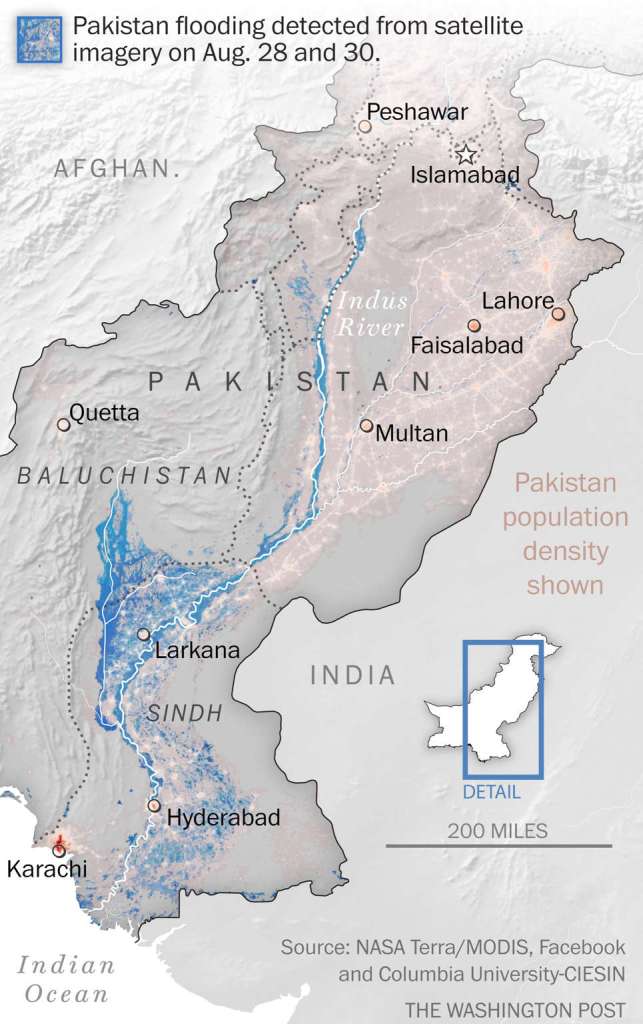
“Those terrible floods in Pakistan. The poor Pakistanis have not contributed at all really to climate change, but there there was a third of the nation under water”.
The claims of a third of the country originated from Pakistan’s Climate Minister at the time, as reported by the BBC here.
The claims were quickly rubbished, both by NASA and the UN agency OCHA, which suggested the true figure was about 8%:
Ironically the BBC itself admitted their earlier reports were false, after their radio programme More or Less investigated the matter here. They came to similar conclusions, with an estimate of 10%.
There was no reason therefore why Deben was not challenged in his claim that a third of the country had been under water. The fact that he is a man of authority should have made it even more important that he be challenged.
This is not the first time that Deben has been allowed to get away with outright falsehoods on a BBC programme. In 2018, during an interview with John Humphreys, he was not challenged when he made the palpably false claim that there was a ban on onshore wind farms in England. The BBC’s Executive Complaints Unit found that Deben should have been challenged to ensure listeners were not left with a materially misleading impression.
Fear of earthquakes is preventing Netherlands from pumping gas from a reservoir big enough to insulate Europe from the consequences of their green energy policy failure and Russian energy geopolitics.
Fear of earthquakes is preventing Netherlands from pumping gas from a reservoir big enough to insulate Europe from the consequences of their green energy policy failure and Russian energy geopolitics.
The Massive Gas Field That Europe Can’t Use
Earthquake risks in the Netherlands have locals unwilling to plug the Russia-related energy shortfall.
Beneath the windmill-dotted marshlands of the Netherlands lies Europe’s largest natural gas reserve. The sprawling Groningen field has enough untapped capacity to replace, as soon as this winter, much of the fuel Germany once imported from Russia.
Instead the field is in the process of shutting down, and the Netherlands is rebuffing calls to pump more, even as Europe braces for perhaps its toughest winter since World War II. The reason: Drilling has led to repeated earthquakes, and Dutch officials are loath to risk a backlash from residents by breaking promises.
…
Locals, though, say the continent needs to look elsewhere. Wilnur Hollaar, 50, who’s lived in Groningen for almost two decades, is still seething over the way officials ignored his concerns. “When I bought this house in 2004, it was a palace,” Hollaar says of his home, which was built in 1926 and features stained-glass windows and detailed stonework. But like thousands of homes in the area, it’s been damaged by quakes; it’s full of cracks and the facade is sinking. “My house has turned into a ruin,” he says.
…
European Union Internal Market Commissioner Thierry Breton said in a recent speech that the Netherlands should reconsider its decision to close Groningen, and Vijlbrief has been pressed by counterparts from other EU nations as well, but the country is holding the line for now. Prime Minister Mark Rutte won’t entirely rule out using Groningen to bolster supplies, but “only in an extreme case if everything goes wrong,” he says, and it isn’t needed right now.
The Earthquake risk in this case appears to be real. Houses in the area being extracted have suffered 1.5ft of subsidence to date, caused by the land compacting into the depleted reservoir. The gas field is that big.
Induced Earthquakes from Long-Term Gas Extraction in Groningen, the Netherlands: Statistical Analysis and Prognosis for Acceptable-Risk Regulation
Charles Vlek
Recently, growing earthquake activity in the northeastern Netherlands has aroused con- siderable concern among the 600,000 provincial inhabitants.
There, at 3 km deep, the rich Groningen gas field extends over 900 km2 and still contains about 600 of the original 2,800 billion cubic meters (bcm). Particularly after 2001, earthquakes have increased in number, magnitude (M, on the logarithmic Richter scale), and damage to numerous buildings.
The man-made nature of extraction-induced earthquakes challenges static notions of risk, com- plicates formal risk assessment, and questions familiar conceptions of acceptable risk.
Here, a 26-year set of 294 earthquakes with M & 1.5 is statistically analyzed in relation to increasing cumulative gas extraction since 1963.
Extrapolations from a fast-rising trend over 2001–2013 indicate that—under “business as usual”—around 2021 some 35 earthquakes with M & 1.5 might occur annually, including four with M & 2.5 (ten-fold stronger), and one with M & 3.5 every 2.5 years. Given this uneasy prospect, annual gas extraction has been reduced from 54 bcm in 2013 to 24 bcm in 2017.
This has significantly reduced earthquake activity, so far. However, when extraction is stabilized at 24 bcm per year for 2017–2021 (or 21.6 bcm, as judi- cially established in Nov. 2017), the annual number of earthquakes would gradually increase again, with an expected all-time maximum M $ 4.5.
Further safety management may best fol- low distinct stages of seismic risk generation, with moderation of gas extraction and massive (but late and slow) building reinforcement as outstanding strategies.
Officially, “acceptable risk” is mainly approached by quantification of risk (e.g., of fatal building collapse) for test- ing against national safety standards, but actual (local) risk estimation remains problematic.
Additionally important are societal cost–benefit analysis, equity considerations, and precau- tionary restraint.
Socially and psychologically, deliberate attempts are made to improve risk communication, reduce public anxiety, and restore people’s confidence in responsible experts and policymakers.
…
The 900-km2 large Groningen gas field has been depleted from the original 2,800 bcm to less than 700 bcm by the end of 2016.
This went along with a reservoir pressure reduction of originally 350 bar to less than 100 bar in 50 years’ time.
Extensive gas extraction and the resulting reservoir compaction have caused almost 50 cm (1.5 ft) of soil subsidence and an increasing number of gradually more harmful earthquakes with M & 1.5 to 3.6 after 1990 and so far up to 2014.1
A critical double question for numerous Groningers and the national government in The Hague is: What seismic activity is likely to occur when substantial gas extraction would continue for the next several decades, and how would environmental safety be restored and upheld?
I’m sympathetic to the residents, but the EU is in such a desperate situation, thanks to their green energy policy failures, I suspect the Netherlands government will have no choice but to cave and allow extraction to continue.
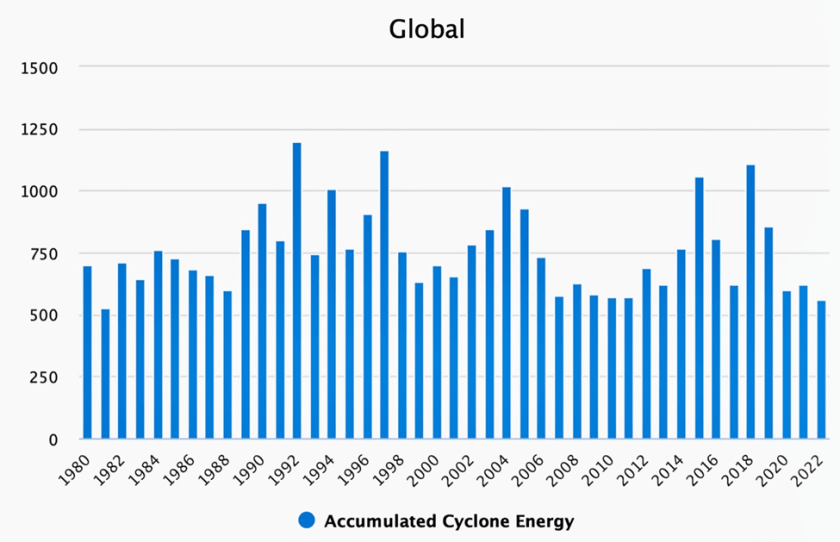
The year 2022 global wide ACE data outcome is about 29% lower than the average over the 30 year-long (1991 through 2020) climatology period tracked by Colorado State University’s Tropical Meteorology Project data base.
Editors Note: Readers may recall that Climate Realism brought attention to the claims and the failures of the media in covering the 2022 Atlantic hurricane season here,here, and here.
Guest essay by Larry Hamlin
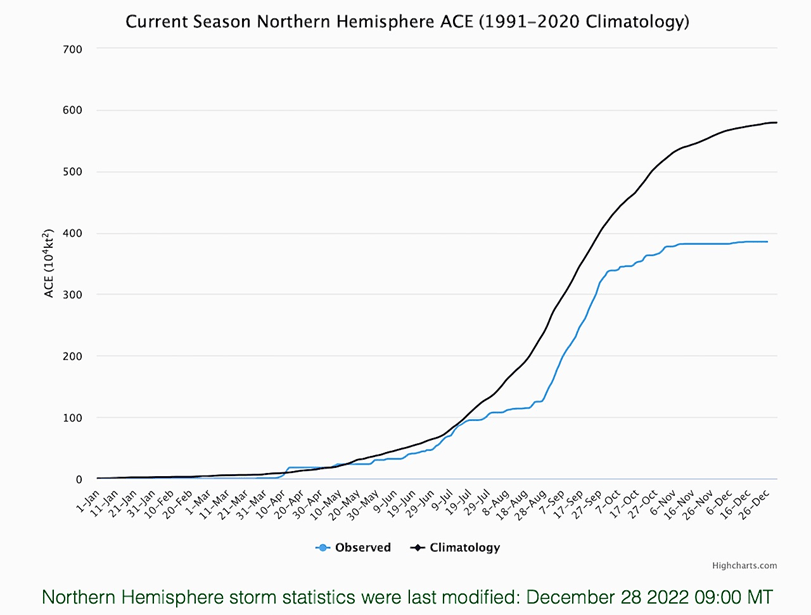
After nearly 4 decades of Democrat driven flawed and failed politically contrived climate alarmist propaganda claims of worsening global climate impacts NOAA’s measured worldwide hurricane season science data for all year 2022 tropical storms shows that global wide storms were at their lowest strength levels in the last 42 years (since 1981) as shown by the ACE (Accumulated Cyclone Energy reflecting the combined frequency, intensity and duration of all storms) data below from Colorado State University’s Department of Atmospheric Science which tracks NOAA’s National Hurricane Center tropical storm data.
The year 2022 global wide ACE data outcome is about 29% lower than the average over the 30 year-long (1991 through 2020) climatology period tracked by Colorado State University’s Tropical Meteorology Project data base.
This decades long measured global wide tropical storm declining strength data trend outcome contradicts the data deficient and unsupported climate alarmist claims that tropical storms and hurricanes are growing ever stronger because of “climate change” that is falsely hyped by both the climate alarmist propaganda media and their Democrat political leaders.
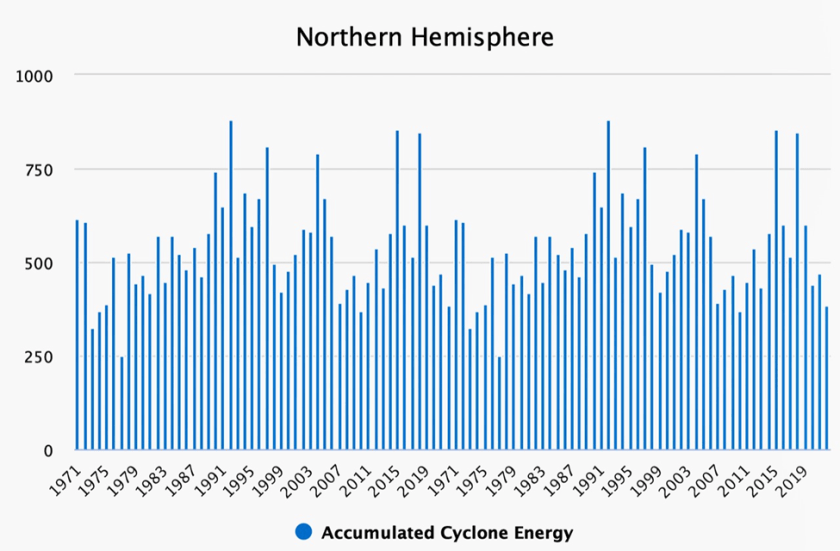
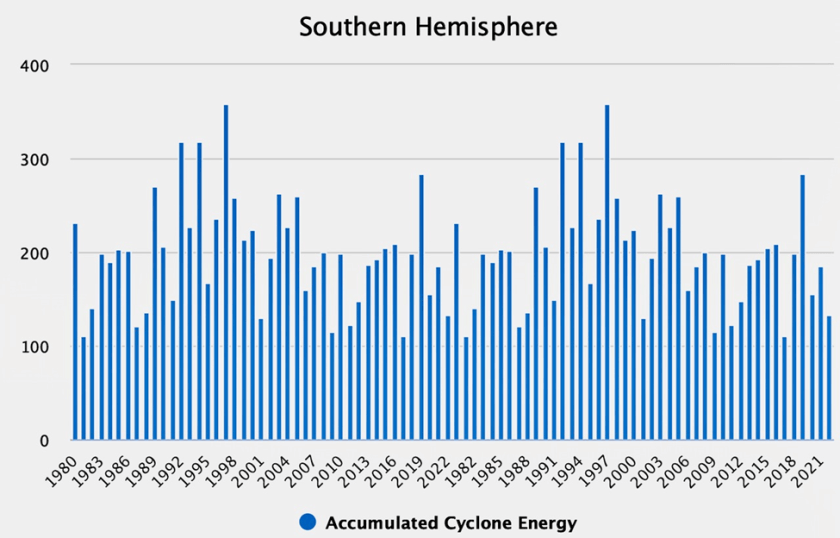
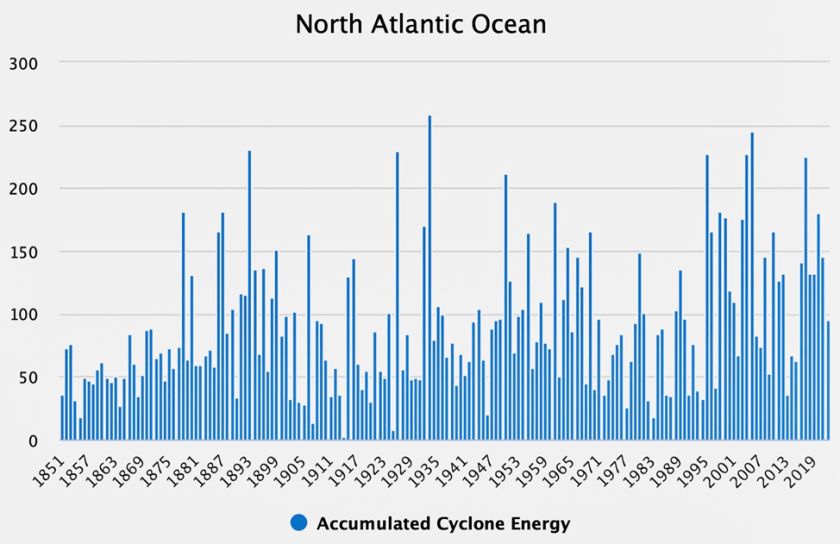
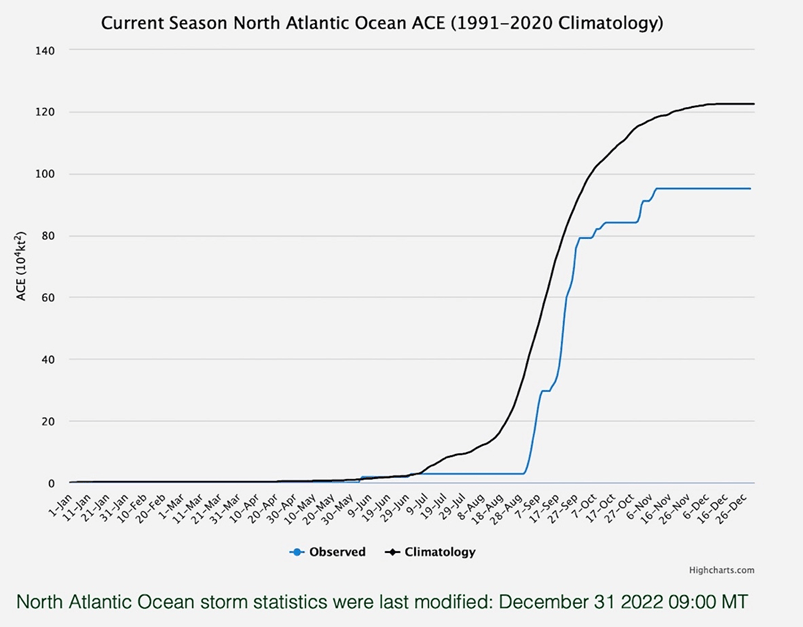
Additionally, NOAA’s science measured tropical storm data through year 2022 clearly demonstrates that global hurricanes are not trending stronger in numbers, duration or intensity in the Northern Hemisphere Oceans, Southern Hemisphere Oceans and North Atlantic Ocean (as shown by ACE data graphs for these ocean regions below) despite the alarmist media concealment of this science data from public view.
The Northern Hemisphere year 2022 ACE is about 33.5% lower than the average of the 1991 to 2020 climatology period, the Southern Hemisphere year 2022 ACE is about 36% lower than the 1991 to 2020 climatology period and the North Atlantic year 2022 ACE is about 22.4% lower than the 1991 to 2020 climatology period.
The Northern Hemisphere Oceans and North Atlantic Ocean year 2022 Colorado State University Real Time TC Statistics ACE profiles compared to the 1991 to 2020 climatology 30-year period are shown below that clearly display the significantly reduced year 2022 ACE levels despite flawed propaganda hype by climate alarmists and media to falsely fabricate claims of increasing storm strengths.
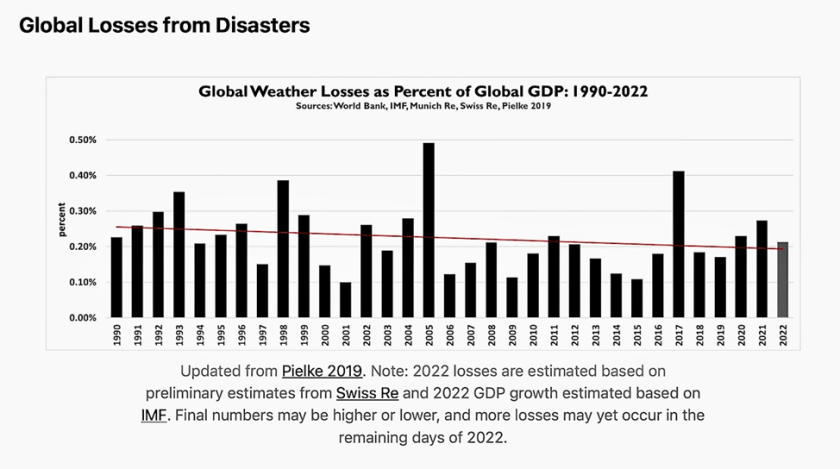
Not only does the climate alarmist media conceal data clearly establishing the fact that global and ocean region hurricanes and tropical storms are not trending stronger they are also grossly misrepresenting the trend in global weather storm costs by erroneously using absolute dollar cost trend comparisons between years instead of using comparisons of these costs configured as a percentage of GDP (Gross Domestic Product) data as established by the United Nations as the appropriate economic basis for making weather damage yearly cost comparison trends.
AP climate alarmist propaganda reporter Seth Borenstein and other alarmist reporters continue to falsely misrepresent cost trend comparisons of global weather events by deliberately concealing GDP global weather event cost trend data comparisons and incompetently reporting these costs in absolute dollars as noted below from a recent AP article.
“That’s the state of climate change in the 2020s that $268 billion in global disaster costs is a 12% drop from the previous year, where damage passed $300 billion.
The number of U.S. weather disasters that caused at least $1 billion in damage is only at 15 through October and will likely end the year with 16 or 17, down from 22 and 20 in the last two years, according to the National Oceanic and Atmospheric Administration. But because of Hurricane Ian, overall damage amounts are probably going to end up in the top three in American history.
Weather disasters, many but not all of them turbocharged by human-caused climate change, are happening so frequently that this year’s onslaught, which 20 years ago would have smashed records by far, now in some financial measures seems a bit of a break from recent years.”
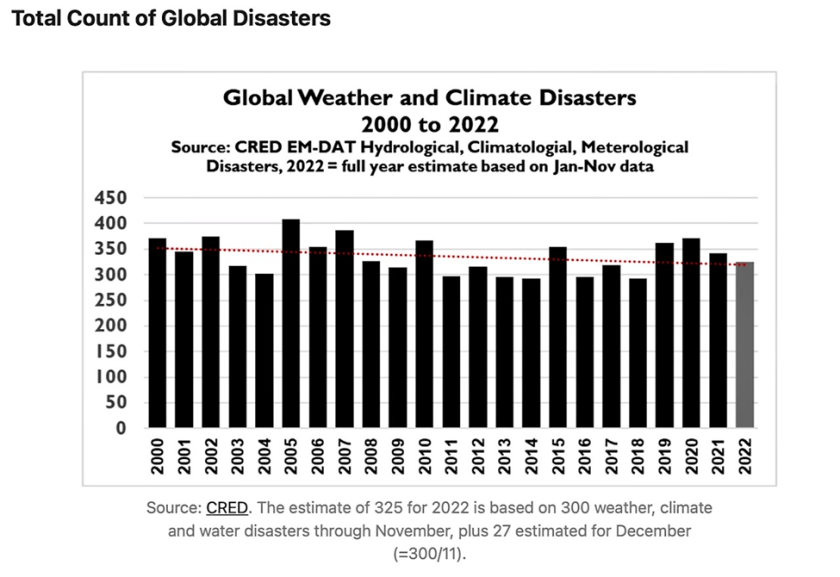
The graphs below address that the total number of global weather events and their costs as expressed as a percentage of GDP are not trending upward which contradicts claims of increasing cost trends as erroneously hyped by climate alarmist flawed methodology which inappropriately use absolute dollars figures in attempting to make these cost trend comparisons.
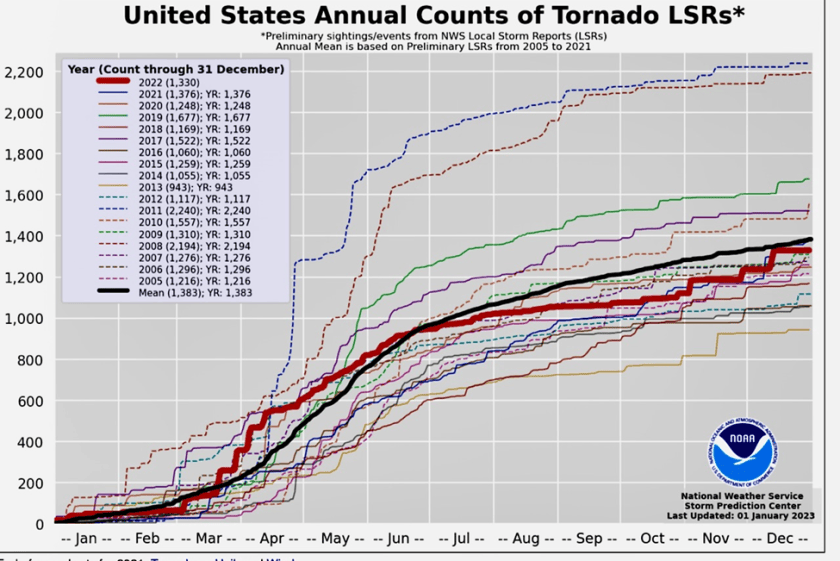
The climate alarmist AP article noted above as well as many other climate alarmists articles trying to falsely portray increasing severe weather events fail to address at all the lack of increasing numbers and severity of U.S. tornadoes over the last 18 years (2005 through 2022) as shown by the latest NOAA data below which shows only 5 of the last 18 storm year totals were above the mean range with the two highest values occurring 12 to 15 years ago. Year 2022 totals were below the mean.
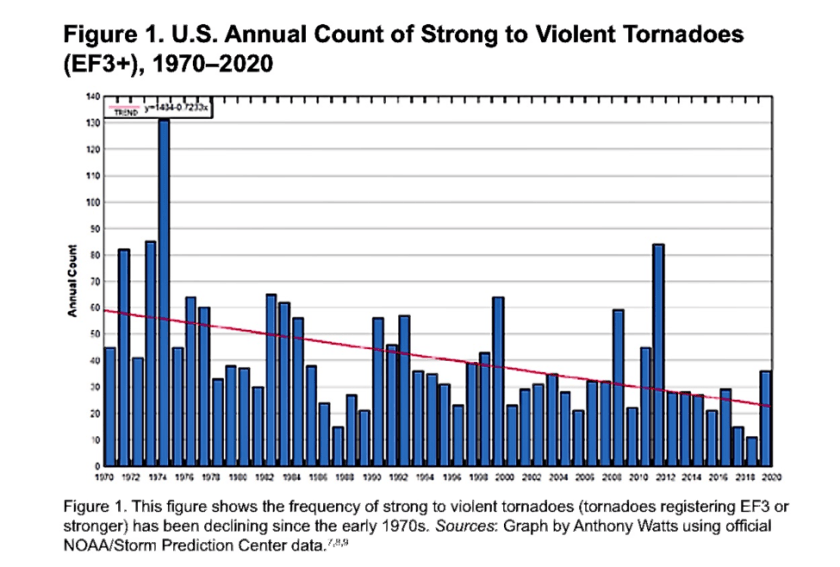
The number of strongest tornadoes (EF3+) has in fact been consistently declining from 1970 through 2020 as shown by NOAA data in the graph below.
This blatant failure by the climate alarmist media to address the reality of declining weather event severity and instead conceal such data is just another example establishing the dishonesty and deception of climate alarmist propaganda articles in their efforts to hide measured science data from public view and instead rely upon science data unsupported claims and contrived propaganda.
NOAA’s measured hurricane strength data both globally and regionally over many decades exposes the flawed and failed climate alarmist claims that hurricanes are growing stronger as being both erroneous and dishonest.
UN adopted methodology of measuring global weather storm cost trends using percentage of GDP assessments (instead of flawed assessments using absolute dollar yearly total comparisons as employed by climate alarmists) show the costs of global weather events are not trending upward as erroneously claimed by climate alarmists and media.


 The Heartland Institute






You must be logged in to post a comment.